Even if this piece of recent psych research didn't reveal such interesting principles about the use of fMRI in researching the functions of specific brain regions, it would be worth sharing just for its hilariousness.
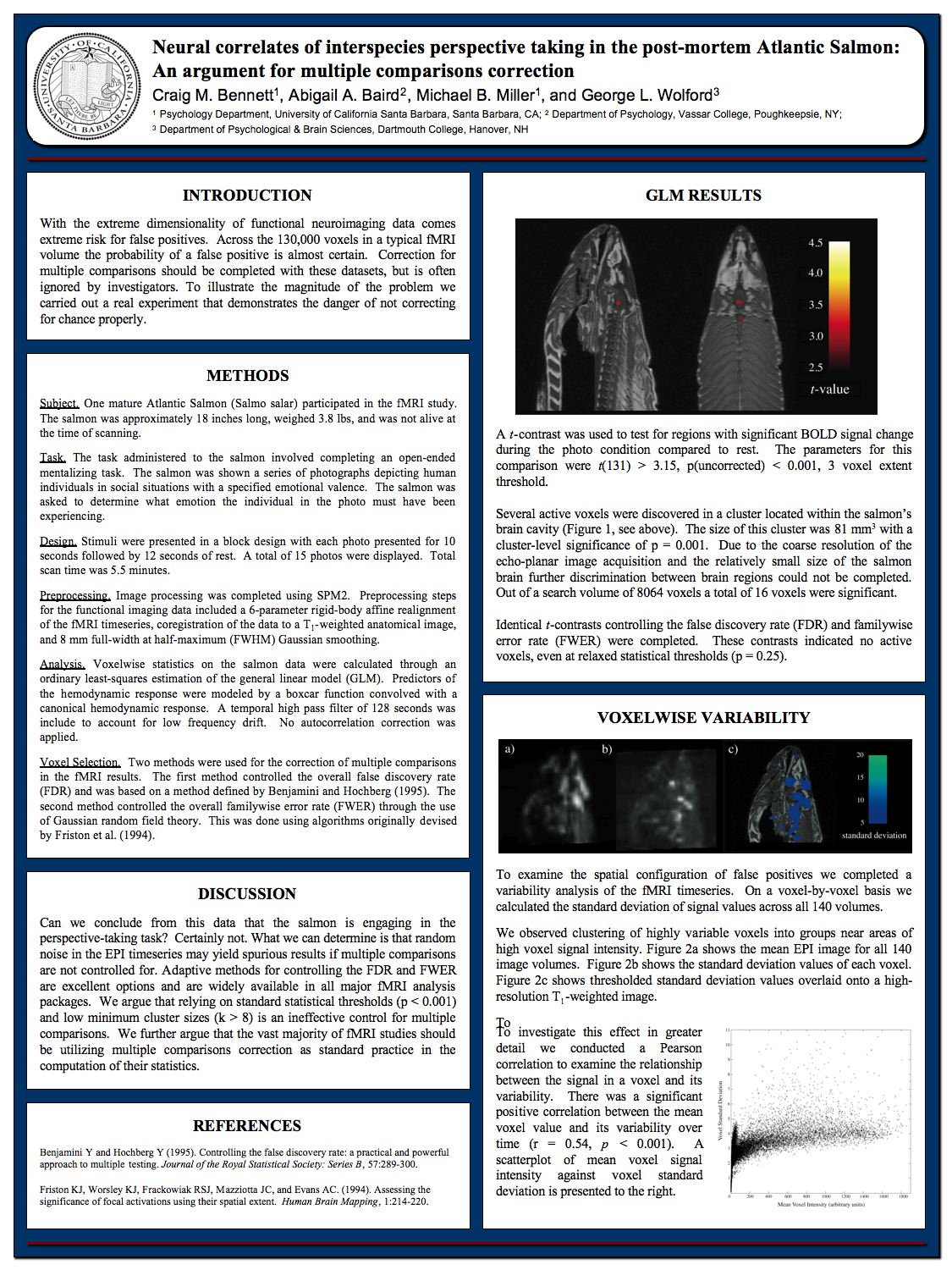
A team of neuroscientists, led by Craig Bennett of the University of California, Santa Barbara recently conducted an fMRI on a
dead fish (specifically, an Atlantic salmon) while showing it pictures of people. The result: statistically significant registers of electrical activity in the fish's tiny brain!
Whoa! The brains of dead fish respond when their unliving eyes are forced to stare at pictures of humans?! Not so fast....
The researchers are not claiming some sort of zombie-like post-mortem affection fish display toward humans. Rather, they are using this result to point out that sometimes fMRI's give
false positives because of how much data they are able to report. They suggest that the cutoff for statistical significance (normally a p-value of .05) when using fMRI's may need to be lowered. In other words, the currently accepted level of risk that results occurred by sheer chance (p-value) may be too high for the amount of data being collected by these sophisticated techniques: they are likely to show statistically significant activity when, in actuality, it's not there (as in the dead fish).
My favorite part of this research? The cool title the researchers chose for their project:
"Neural correlates of interspecies perspective taking in the post-mortem Atlantic salmon: An argument for multiple perspectives comparison." Nice work, fellows!
Click
here to see the poster presentation on this research.