In class on Thursday (A-Day) or Friday (B-Day) we will begin to explore the various research methods used in modern psychological science, including surveys.
When prompted by your instructor, please take a moment to complete the survey below. Your responses will remain anonymous and participation is voluntary.
NOTE: Because responses are limited to CFHS students, you must be signed in to your .chipfalls.org Google account to access the form. If you are having trouble accessing the form, try using this link.
Showing posts with label Research Methods. Show all posts
Showing posts with label Research Methods. Show all posts
Wednesday, September 6, 2017

Tuesday, September 13, 2016
Example: Surveys
Today in class we will be exploring the pros and cons of various descriptive research methods, including surveys.
In order to facilitate our discussion about the potential benefits and limitations of surveys, you can choose to participate in this exploratory exercise from Time magazine: How in Touch Are You with America on Gun Control?
The activity will ask you several demographic questions and gauge your opinion on gun control legislation. You will then be shown how your results compare to national samples.
In order to facilitate our discussion about the potential benefits and limitations of surveys, you can choose to participate in this exploratory exercise from Time magazine: How in Touch Are You with America on Gun Control?
The activity will ask you several demographic questions and gauge your opinion on gun control legislation. You will then be shown how your results compare to national samples.
Tuesday, September 15, 2015
Preparing for Your History, Approaches, and Research Methods Test
On Thursday, you'll take your first unit test in AP Psychology! I know you find it important to prepare thoroughly, so I'm hoping the links in this post are helpful as you begin your review.
Study Tools:
Flashcards:
Unit I: History Approaches
Unit II: Research Methods
Slides:
The Story of Psychology
Contemporary Psychological Approaches
Research Methods and Stats
Study Tools:
- Your unit objectives. Can you confidently do all of the things described on this list?
- The MC study guide you received in class (on Friday, Sept. 11). Harness the power of retrieval practice by treating this as a practice test.
- Quizlet Flashcards for Unit I and Unit II.
- Need a quick video refresher of major topics from this unit? Here are the Crash Course Videos on Psychology's History and Research Methods.
- You might want to check out the resources in your etext, including the practice quizzes available there (2 per unit). You will need the login info you created when we registered these in class.
- Still want MORE practice multiple choice questions? Here are some on psychological approaches, and some more on research methods.
- I'm also posting the slides we've used this unit below, along with embedded flashcards and some helpful videos.
Flashcards:
Unit I: History Approaches
Unit II: Research Methods
Slides:
The Story of Psychology
Contemporary Psychological Approaches
Research Methods and Stats
Thursday, September 10, 2015
Fun with Correlations!
Today in class we'll be exploring correlational research designs and related statistical techniques. We'll be using a couple of links for today's activities.
- Activity One: Matching Scatterplots and Correlation Coefficients
We also may have the chance to investigate some bizarre correlations. If not, these links are worth checking out on your own time:
Monday, September 7, 2015
Wason's Rule Detection Task
Try out this fun problem-solving challenge! We will discuss this in class in relation to the scientific method. Once you've solved it, don't share the answer with your neighbor until we're ready to discuss it!
Friday, September 27, 2013
Study Resources for Your History & Methods Test
Whew! That unit flew by...and now students are preparing for their test on History/Approaches & Research Methods, which will happen on Monday, Sept. 30th. If you like, you are welcome to join us on Sunday, Sept. 29th at 5 PM, for organized review.
In addition, I've compiled some online study tools for you below.
Flashcard sets (2) for this unit are also embedded below! :) Happy studying!
In addition, I've compiled some online study tools for you below.
- An online multiple choice quiz on Schools of Psychology.
- An online multiple choice quiz on Research Methods.
- A 5-minute video reviewing Correlational Methods & Stats
- A video on experimental methods.
- A review of basic psych statistics (descriptive & inferential)
- A video review of the difference between random assignment & random selection.
Flashcard sets (2) for this unit are also embedded below! :) Happy studying!
Wednesday, September 25, 2013
Basic Psychological Statistics
Before you left class today, you should have received this practice worksheet that requires you to apply some statistics knowledge to hypothetical quiz scores. Your textbook does cover these topics, and many people have encountered them before in other classes, so I'm hoping for many of you this is a simply a matter of review.
However, because some of you might feel lost or in need of additional help, I'm embedding below a video that I made for last year's students regarding this topic. Be warned, I was cutting it close when I recorded this and you'll hear the bell ringing toward the end. However, it should clear up confusion regarding the various descriptive and inferential statistics you'll need to be familiar with for this unit.
Additionally, if you feel you want more practice matching correlational coefficients with scatterplots, here's the link to the website we used in class today.
Having troubles playing the video? If the player above doesn't work, try here.
However, because some of you might feel lost or in need of additional help, I'm embedding below a video that I made for last year's students regarding this topic. Be warned, I was cutting it close when I recorded this and you'll hear the bell ringing toward the end. However, it should clear up confusion regarding the various descriptive and inferential statistics you'll need to be familiar with for this unit.
Additionally, if you feel you want more practice matching correlational coefficients with scatterplots, here's the link to the website we used in class today.
Having troubles playing the video? If the player above doesn't work, try here.
Monday, September 10, 2012
Notes: 6th & 7th Hour 9/11/12
Hi all!
Since I have to be at a meeting on the afternoon of Tuesday, Sept. 11, I've recorded notes & instructions for the demos and posted that here. Hope your class & quizzes go well!
Note: Yeah, I know I messed up on describing the two outcomes of the first demo. Cut me some slack, Jack. Also, there was fly in the room when I was recording that become increasingly annoying throughout the video. That should be entertaining for you.
Bonus? If you missed any of this you can go back & re-watch. Or, if you didn't quite finish before it was time for the quiz, you can watch at home. :)
Since I have to be at a meeting on the afternoon of Tuesday, Sept. 11, I've recorded notes & instructions for the demos and posted that here. Hope your class & quizzes go well!
Note: Yeah, I know I messed up on describing the two outcomes of the first demo. Cut me some slack, Jack. Also, there was fly in the room when I was recording that become increasingly annoying throughout the video. That should be entertaining for you.
Bonus? If you missed any of this you can go back & re-watch. Or, if you didn't quite finish before it was time for the quiz, you can watch at home. :)
Wednesday, September 14, 2011
New Quizlet Flashcards Available!
For most subjects in AP Psych, I have created online flashcards sets through Quizlet for your reviewing pleasure! I recently updated and added new terms/people to the two sets for this unit: History & Approaches and Research Methods. If you access them using the links provided, you'll be able to play games and test yourself on major terms and people for this unit.
I am in the process of transferring all of my Quizlet links to the Study Resources page of this website. So, you should be able to access them there at any time. Please be patient with me as I make the switch with all of the vocab review links.
If you are in the mood for a very quick review, you can use the applets I've embedded in this post for simple flashcard review. Happy studying!
History & Approaches Set (Prologue):
Research Methods Set (Chapter 1):
I am in the process of transferring all of my Quizlet links to the Study Resources page of this website. So, you should be able to access them there at any time. Please be patient with me as I make the switch with all of the vocab review links.
If you are in the mood for a very quick review, you can use the applets I've embedded in this post for simple flashcard review. Happy studying!
History & Approaches Set (Prologue):

Research Methods Set (Chapter 1):
Thursday, September 8, 2011
The Scientific Attitude: A "Baloney Detection Kit"
For the next few days in class, we will become increasingly familiar with the research methods used by psychologists. Thus, we will be talking a great deal about the scientific approach to answering research questions (which differs considerably from political, religious, or other methods of asking and answering questions). This will involve understanding what is meant by the phrase "scientific theory" and beginning to think with the skepticism of a scientist when presented with claims about human abilities and behavior.
The video below features an excellent description of this scientific "attitude" from famed skeptic Michael Shermer. He describes science as a "Baloney Detection Kit," and describes some general rules for thinking scientifically.
Some things to watch for:
The video below features an excellent description of this scientific "attitude" from famed skeptic Michael Shermer. He describes science as a "Baloney Detection Kit," and describes some general rules for thinking scientifically.
Some things to watch for:
- His descriptive of our tendency to see patterns, especially illusory correlations
- His specific mention of confirmation bias as a source of error
- In point #3: the need for replication of research results
- In point #9: a description of the nature of scientific theories...and how they are different from what most of us casually refer to as "theories"
My personal favorite quote: "You want a mind open enough to accept radical new ideas, but not so open that your brains fall out."
Friday, May 13, 2011
And we're back!
Hooray for Blogger being up and running again! That makes finding THIS LINK TO YOUR RESEARCH PROJECT APPROVAL FORM so much easier.
Be sure to save a copy to GoogleDocs and share it with your team members so you can all work on the form simultaneously, if needed. The completed version is required for approval no later than Friday, May 20, but I would advise you to get it to Mrs. Welle ASAP so that you can begin your data collection without delay.
Be sure to save a copy to GoogleDocs and share it with your team members so you can all work on the form simultaneously, if needed. The completed version is required for approval no later than Friday, May 20, but I would advise you to get it to Mrs. Welle ASAP so that you can begin your data collection without delay.
Sunday, September 12, 2010
Experimental Design
Tomorrow (9/13/10) in class you will get your Practice Experimental Design assignment. This will require you to work with a team (two other students) to put together an idea for a hypothetical psychological experiment.
Use the link provided to complete the form with the required information. Remember to do a "save as" and save the file to your computer before filling in your group's information, otherwise the changes you make will be on everyone's form!
Completed forms can be printed off and physically handed in, or emailed to Mrs. Welle. Please double check with me in class to make sure I received any emailed assignments, though, because the school's SPAM filter is very aggressive and may block you. The assignment is due Wednesday, 9/15/10.
Use the link provided to complete the form with the required information. Remember to do a "save as" and save the file to your computer before filling in your group's information, otherwise the changes you make will be on everyone's form!
Completed forms can be printed off and physically handed in, or emailed to Mrs. Welle. Please double check with me in class to make sure I received any emailed assignments, though, because the school's SPAM filter is very aggressive and may block you. The assignment is due Wednesday, 9/15/10.
Wednesday, May 5, 2010
Just Added: Research Methods Quizlet
Thanks to the efforts of classmate Allie Tanzer, we have a new quizlet for our reviewing needs! Allie put together a list of 34 terms from our Research Methods unit (Chapter 1).
Feel free to give it a run-through as you are brushing up on those Chapter 1 notes.
Here's the link: Research Methods Quizlet
Feel free to give it a run-through as you are brushing up on those Chapter 1 notes.
Here's the link: Research Methods Quizlet
Sunday, September 27, 2009
Scientists Identify Brain Areas Linked to Emotion in Dead Fish?
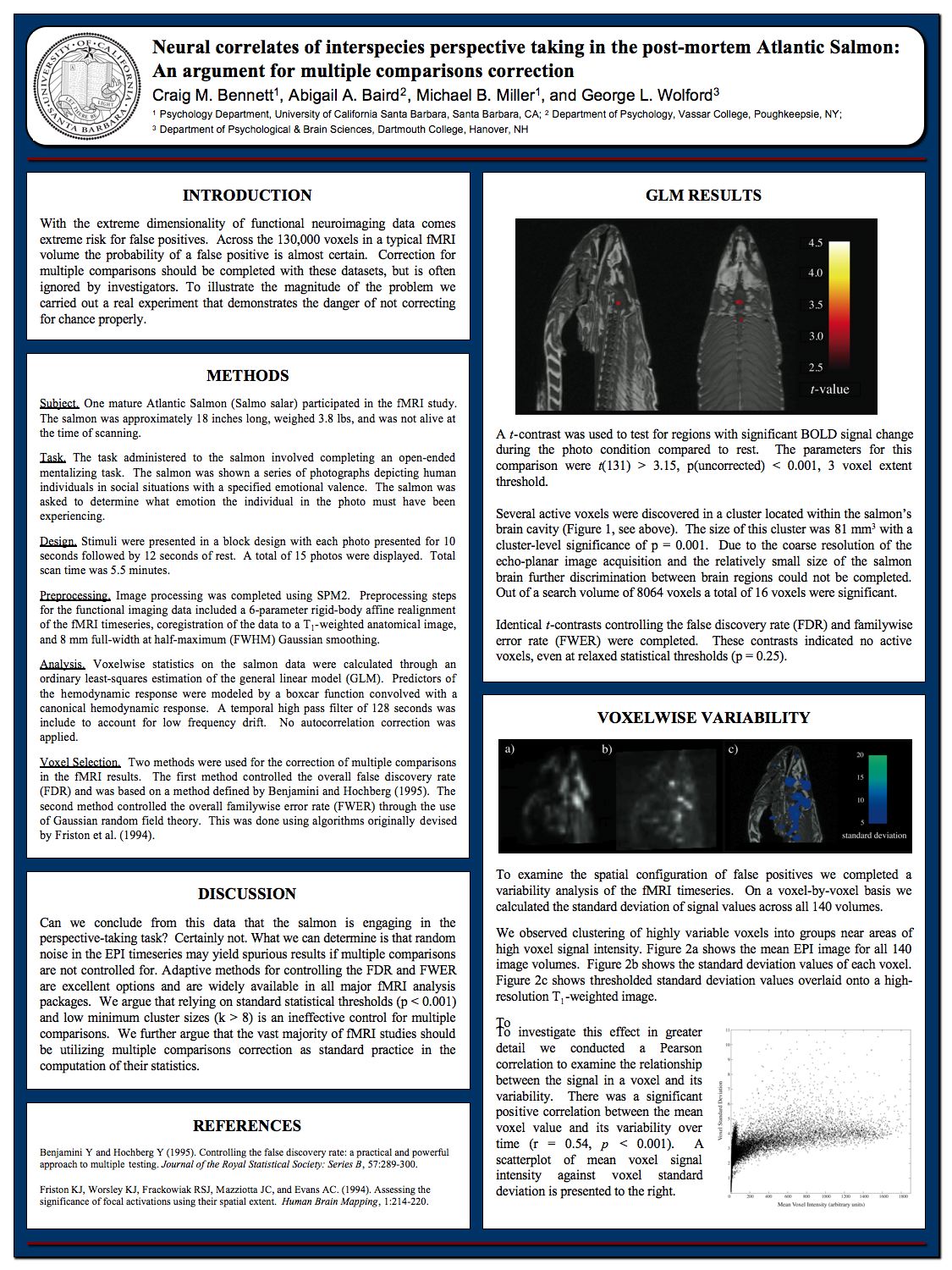
 Even if this piece of recent psych research didn't reveal such interesting principles about the use of fMRI in researching the functions of specific brain regions, it would be worth sharing just for its hilariousness.
A team of neuroscientists, led by Craig Bennett of the University of California, Santa Barbara recently conducted an fMRI on a dead fish (specifically, an Atlantic salmon) while showing it pictures of people. The result: statistically significant registers of electrical activity in the fish's tiny brain!
Whoa! The brains of dead fish respond when their unliving eyes are forced to stare at pictures of humans?! Not so fast....
The researchers are not claiming some sort of zombie-like post-mortem affection fish display toward humans. Rather, they are using this result to point out that sometimes fMRI's give false positives because of how much data they are able to report. They suggest that the cutoff for statistical significance (normally a p-value of .05) when using fMRI's may need to be lowered. In other words, the currently accepted level of risk that results occurred by sheer chance (p-value) may be too high for the amount of data being collected by these sophisticated techniques: they are likely to show statistically significant activity when, in actuality, it's not there (as in the dead fish).
My favorite part of this research? The cool title the researchers chose for their project: "Neural correlates of interspecies perspective taking in the post-mortem Atlantic salmon: An argument for multiple perspectives comparison." Nice work, fellows!
Click here to see the poster presentation on this research.
Monday, September 14, 2009
The Placebo Effect Treatment

During our recent class discussion on experimental design, I mentioned a well-known phenomenon in psychiatric medicine: the placebo effect. This is a situation where a patient responds as they believe they should under the influence of a drug, when in actuality they are receiving a placebo (inert substance). For example, reporting a decrease in pain after taking what you thought was an aspirin (but actually was a Skittle).
Last year, a study was published in the Journal of Internal Medicine that found 45% of surveyed doctors had prescribed a placebo to a patient during clinical practice. Obviously this raises questions about the ethics of using placebos in treatment (as opposed to simply in research).
What do you think? Is it okay for doctors to be prescribing placebos (and thus, in some ways, deceiving their patients)?
And, speaking of fake drugs, check out these:
FDA Approves Depressant for Annoyingly Cheerful (caution: strong language)
Progenitorivox: Best Drug Ever (just watch the side effects)
Panexa: Ask Your Doctor for a Reason to Take It
Thanks to MindHacks for the links.
Wednesday, September 2, 2009
Great Example of Case Study: The Woman Who Had No Sense of Personal Space

If, by now, you are into the reading for Chapter 1 (don't worry, I'll post some cool stuff for the Prologue soon), you'll have come across one particular type of research method in psych: the case study.
Though limited in the conclusions you can draw from them, case studies are a great way to study one individual, often with a weird (i.e. rare) condition, in depth.
My latest favorite case study comes to us via the blog of the British Psychological Society and involves a women, called S.M., who apparently has no sense of personal space. This is a great example of the kind of questions that can (and cannot) be answered via case studies.
Subscribe to:
Posts (Atom)